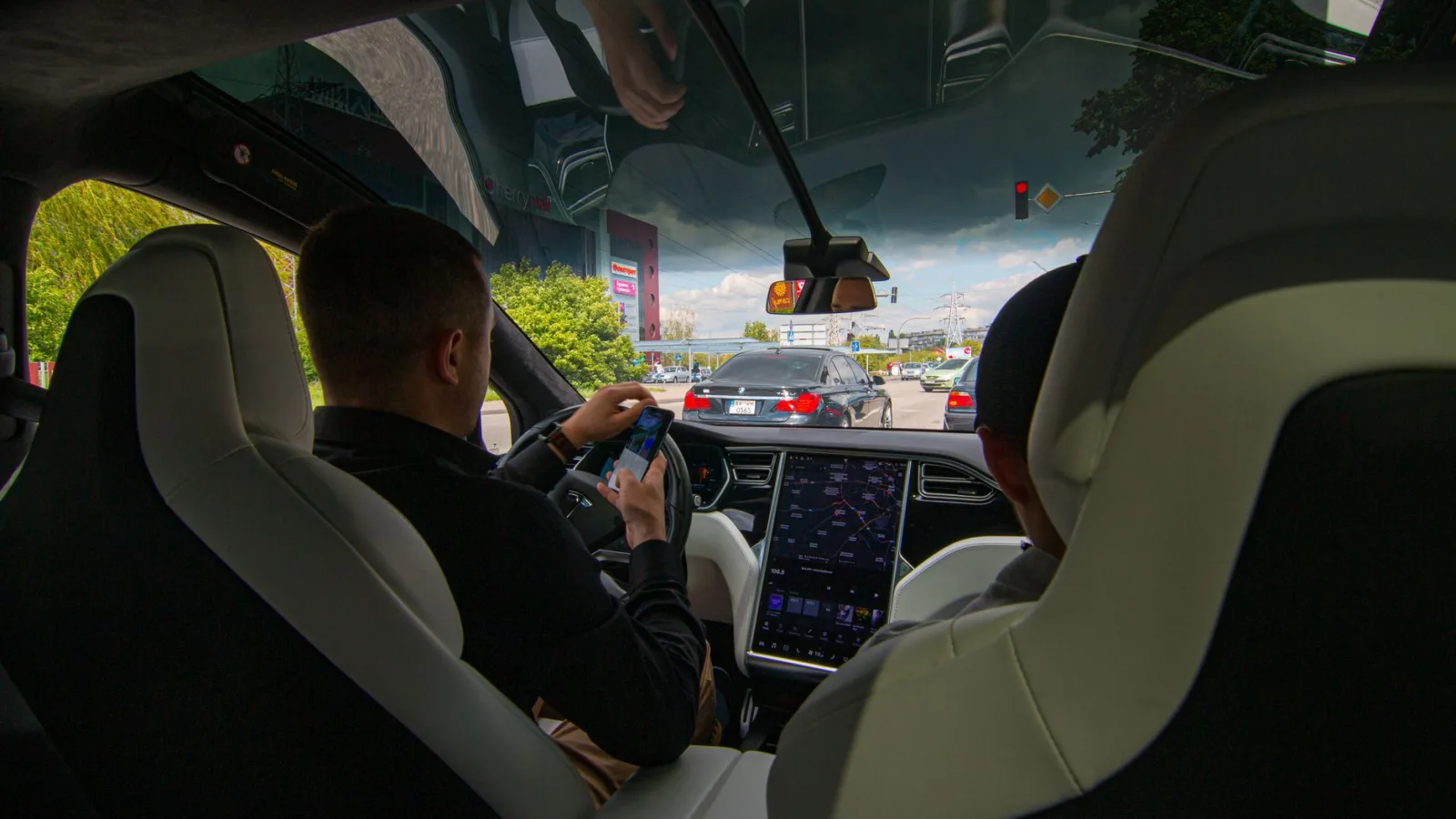
Some Tesla owners have reported that their vehicles' Autopilot computers are overheating or failing following the rollout of the company's latest Full Self-Driving (Supervised) software update, according to posts shared on social media platform X.
The reports centre on cars equipped with Tesla's older Hardware 3 (HW3) computer, which powers the company's Autopilot and FSD systems. Owners say that since updating to Tesla's new FSD V14 Lite software, their vehicles' computers have experienced temporary shutdowns that make FSD unusable for a period, while others say the hardware has failed outright.
Several owners posting on X said their cars' computers reached temperatures as high as 102 degrees Celsius (215 degrees Fahrenheit) after installing the update — roughly double the computer's normal idle temperature. By comparison, Nvidia's H100 datacentre GPU, a high-performance chip used in AI computing, has a maximum operating temperature of 87 degrees Celsius.
Tesla's system is designed to automatically disengage FSD when the onboard computer exceeds 90 degrees Celsius, and to keep the software locked out until the computer cools. Some owners who experienced problems said they checked their vehicle's service mode and found evidence of overheating, while others reported FSD becoming unavailable after the update without specifying a temperature reading.
A number of owners said they were told by Tesla service centres that they needed a replacement Autopilot computer. In one case shared on X, an individual described a family member's FSD system failing during a road trip shortly after the V14 Lite update was installed, with a Tesla service centre subsequently advising that the computer needed to be replaced.
The V14 Lite update was introduced as a scaled-down version of Tesla's newest FSD software, designed specifically for vehicles running the older HW3 computer. Tesla's current-generation Hardware 4 computer has significantly greater processing capability than HW3, which has around an eighth of the memory bandwidth and half the memory capacity of HW4. Tesla has also said it plans to double the memory in an updated version of HW4, meaning HW3-equipped vehicles will have roughly a quarter of the memory capacity of newer cars once that upgrade rolls out.
Because HW3 lacks the computing power to run Tesla's full-scale FSD software, the company created the lighter V14 Lite version for older vehicles. Tesla chief executive Elon Musk has previously said that HW3 is not capable of supporting unsupervised self-driving. "Unfortunately, HW3 simply does not have the capability to achieve unsupervised FSD. We did think at one point it would have that," Musk said during Tesla's first-quarter earnings call earlier this year.
Tesla sold between three million and four million vehicles equipped with HW3 between 2019 and 2023. The V14 Lite update began rolling out to owners approximately two weeks before the reports of overheating emerged. It remains unclear how widespread the issue is. Many owners with similar vehicles have reported no problems since installing the update, and it has not been confirmed whether the overheating and hardware failures are directly linked to V14 Lite or caused by another factor.
Tesla did not respond to a request for comment on the reports.
The company has previously said it may need to build dedicated facilities, which Musk has referred to as "micro factories", to upgrade the hardware in customers' older vehicles as part of its transition to more advanced self-driving capability. Tesla stated in 2016 that all of its vehicles were built with the hardware necessary for full self-driving, a claim made in a blog post that the company has since removed from its website. Since then, Tesla has progressed through several generations of onboard computer hardware, from HW2.5 to HW3 and HW4, and has indicated it will move to HW4.5 and beyond to meet the increased computing demands of unsupervised autonomous driving.