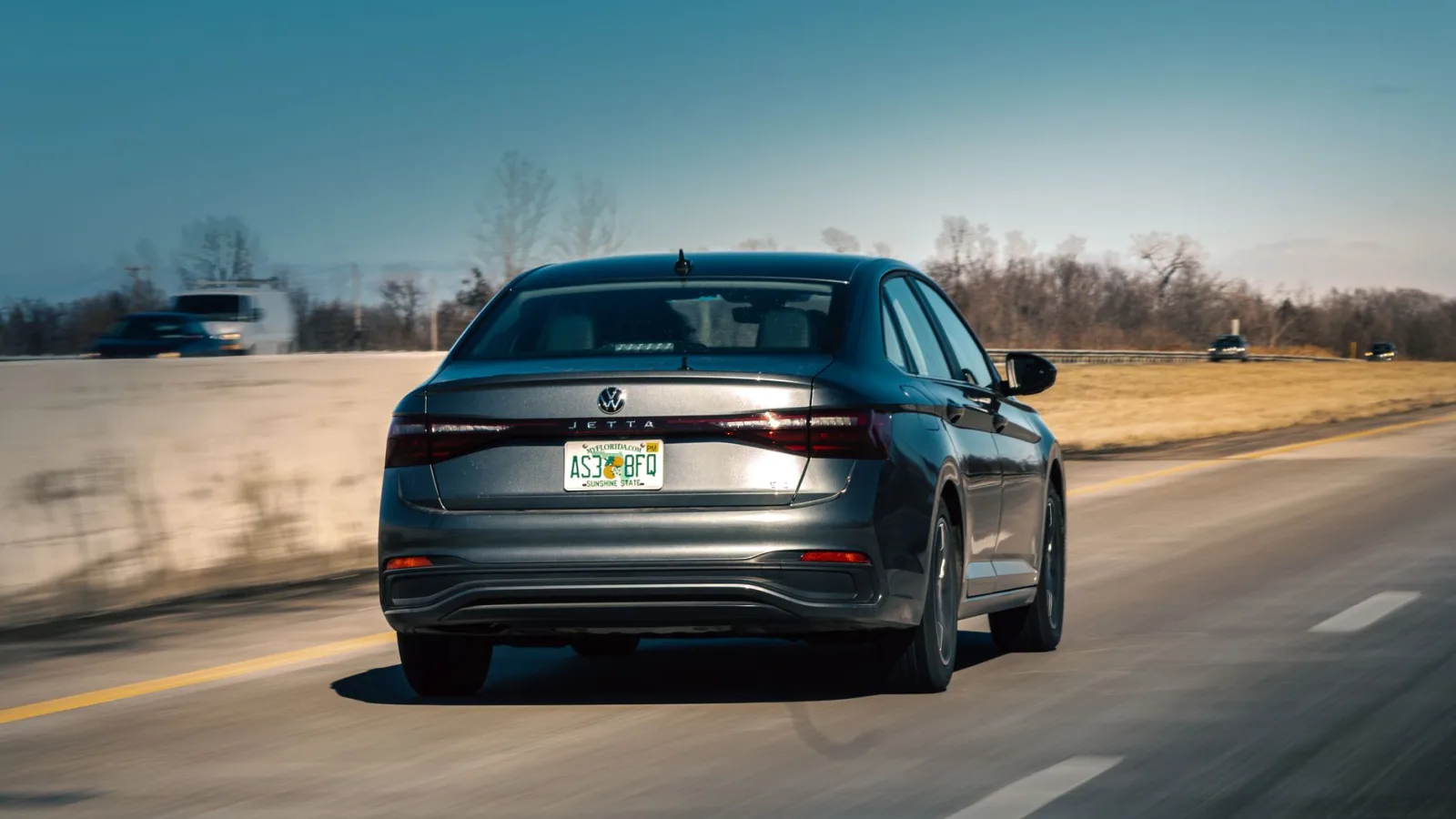
The 2026 Volkswagen Jetta Sport is being positioned as one of the lower-cost new car choices in the US market, with a starting price of $25,305 and fuel economy figures aimed at buyers trying to keep purchase and running costs down.
At a time when the price of new cars remains a concern for many households, the Jetta Sport sits close to the bottom end of the market for buyers who still want a factory-new vehicle from a franchised dealer. It is not the performance-focused Jetta GLI, but a more conventional compact saloon with a small turbocharged petrol engine, front-wheel drive and an automatic gearbox.
The model uses Volkswagen’s 1.5 litre turbocharged four-cylinder engine, the same basic unit fitted across the wider Jetta range. It produces 158hp and 184lb ft of torque, sent to the front wheels through an eight-speed automatic transmission.
Volkswagen’s engine uses a modified Miller cycle, a design intended to improve efficiency by closing the intake valves earlier than in a more conventional engine cycle. The relatively high 11.5:1 compression ratio helps the small turbocharged unit deliver usable output while also supporting the car’s economy figures.
The Jetta Sport’s official US fuel economy rating is 33mpg combined, with 29mpg in city driving and 40mpg on the motorway, equivalent to 7.2, 8.1 and 5.8 litres per 100km respectively. Those figures put it ahead of some similarly priced petrol rivals, although hybrid models can deliver stronger economy at a higher purchase price.
Drivers should not expect a performance model despite the Sport badge. A recent road assessment of the car found that the engine’s response can be difficult to manage smoothly in slower traffic, particularly as the turbocharged torque arrives more strongly above lower engine speeds. The car does not offer separate sport or economy driving modes, leaving one throttle setting for all conditions.
The same assessment found that using the gearbox’s S setting or manual shift mode could make the car more predictable by keeping the engine in a more suitable rev range. That approach may improve response during more open-road driving, although it can also reduce fuel economy because the transmission holds lower gears for longer.
For everyday buyers, the more important question is likely to be whether the Jetta Sport’s low entry price brings enough usable equipment. The car retains some features that are becoming less common in new vehicles, including a physical key that must be inserted into the steering column to start the engine. Remote locking is included, but push-button start is not part of the package.
The cabin still provides several modern essentials. Apple CarPlay is included, along with USB-C ports and an 8in infotainment display. The steering wheel uses physical multifunction buttons rather than the capacitive controls that have attracted criticism in some other Volkswagen models. Climate controls are placed on a capacitive panel, which is backlit at night.
The Jetta Sport also uses electronic brake intervention to help manage traction at the front axle, simulating some of the effect of a limited-slip differential by slowing a slipping wheel and directing torque to the side with more grip. That does not turn it into a performance saloon, but it can help the car feel more composed when cornering at sensible road speeds.
The model’s position in the range is central to its appeal. It is the second-cheapest version of the Jetta and is aimed at buyers who have placed price, fuel use and basic new-car security above additional convenience features or stronger performance. For motorists who have not bought a new car for several years, the $25,305 price also reflects how far entry-level vehicle costs have risen across the market.
The 2026 Volkswagen Jetta Sport therefore underlines a narrowing but still available part of the new car market: the affordable compact petrol saloon. It offers competitive economy and a relatively low purchase price, while requiring buyers to accept simpler equipment and some compromises in drivability.