
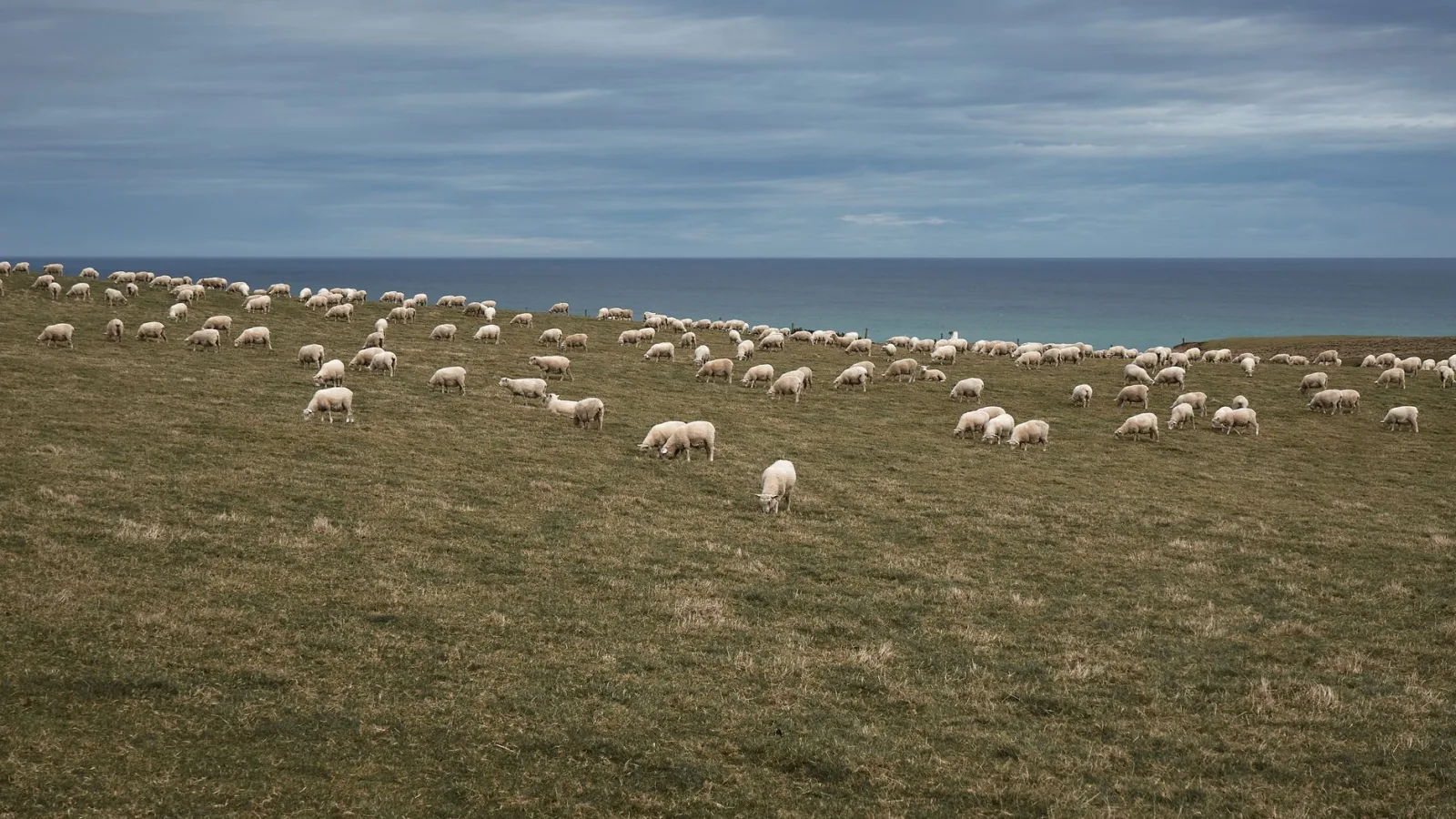
New Zealand’s wool industry is showing signs of recovery after decades of decline, with farmers reporting improved returns and industry figures pointing to renewed international demand for natural fibres.
The shift follows a long period in which wool prices fell, production declined and many sheep farmers reduced flock sizes or moved land into more profitable uses. The sector, once central to New Zealand’s agricultural economy, has been affected by competition from synthetic alternatives, changing global demand and rising shearing costs.
John Hargreaves, whose family has farmed sheep and beef in Kaiwaka, north of Auckland, for generations, said his wool was now making money for the first time in about six years. His family farm had 3,000 ewes in the 1960s, but the flock has gradually fallen to just over 1,700 as the economics of wool deteriorated.
“We’re now covering our shearing costs and making some sort of a profit,” Hargreaves said.
Sheep farming and wool production dominated New Zealand agriculture for much of the 20th century. Sheep numbers peaked at more than 70 million by the 1980s, equivalent to roughly 22 sheep for every person in the country at the time.
That position weakened after economic reforms in the 1980s and a fall in global wool demand as synthetic fibres became more widely used. More recently, some farmers have converted pasture into forestry blocks or dairy farms, both seen as more lucrative alternatives. According to StatsNZ, New Zealand now has just over 23 million sheep, or about 4.5 sheep for every person.
Industry figures say a combination of tight global wool supply and higher costs for synthetic fibres is now improving the outlook. Dave Burridge, national wool auction manager for PGG Wrightson, said rising oil prices linked to the Middle East conflict had pushed up the cost of materials used to produce synthetic fabrics.
“The raw material used to produce nylon and polyester fibres, they’ve all gone up in price,” he said, adding that buyers from countries including China and India were being pushed towards natural fibres.
The renewed interest has been reflected in stronger auction prices. In June, New Zealand wool reached its highest prices in 15 years at the PGG Wrightson national auction. Crossbred fleeces sold for between NZ$6.47 and NZ$6.80 a kilogram, while top-quality, good-colour fleeces reached nearly NZ$8 a kilogram.
Demand has also been supported by interest from major international brands. In April, French luxury group Chanel signed an investment deal with Lammermoor Station in Central Otago to part-own and support the production of premium wool. US outdoor clothing company Patagonia visited New Zealand in June to explore wool partnerships, while Turkish carpet manufacturer Kalida Hali struck a deal with Wools of New Zealand in May.
However, the market remains volatile. Wool prices fell at the most recent national auction, held in Christchurch on 30 July. Burridge said the fall was partly because some buyers had stepped back after meeting commitments earlier in the season, and that a pause had been expected after rapid price rises.
“There was always quiet concern by wool industry players that the price had gone up very quickly, like unparalleled rises that we’d never seen before, and … that things were going to probably come off at some stage,” he said.
Despite the latest dip, prices remain about NZ$2 higher than a year earlier, and Burridge said he remained optimistic about the longer-term outlook for wool.
“I feel really excited about the long-term prospects for wool, and convinced that wool will have its day in the sun again,” he said.
Richard Dawkins, wool and meat manager at Federated Farmers, said stronger wool prices had lifted sentiment among farmers, although the mood remained cautious. He said global awareness of sustainability and wool’s attributes had contributed to a more positive outlook.
“That continued awareness globally of sustainability and the attributes of wool – that is a positive outlook,” Dawkins said.
India, New Zealand’s second-largest wool market, is also becoming a more important source of demand for higher-quality wool, Dawkins said. A recent trade deal between New Zealand and India will remove tariffs on wool, a change expected to strengthen exports.
Dawkins said greater domestic support for wool would also be needed to help stabilise the market and rebuild the industry’s position in New Zealand.
“This nation was built off the back of a sheep, built off wool … and that story’s been lost over the decades,” he said. “It’s one thing asking the world to buy our product, but we need to embrace it ourselves as well.”